
Uncategorized
Fingerprint vs Face Recognition Attendance System: The 2026 UAE Business Guide
Jul
With the UAE biometrics market projected to reach a value of 858.3 million dollars by 2034, is your current office infrastructure prepared for the shift toward high-security automation? Many business owners in UAE and Abu Dhabi struggle with the persistent issue of “buddy punching” and the ongoing hygiene concerns surrounding shared touchpoints in the workplace. Deciding between a fingerprint vs face recognition attendance system is no longer just a matter of convenience. It’s a strategic decision that impacts operational security, payroll accuracy, and regulatory compliance.
We understand that you need a solution that balances technical performance with long-term hardware reliability in the unique UAE climate. This 2026 guide provides a comprehensive comparison of biometric performance, security protocols, and installation requirements to help you choose the ideal system for your facility. You’ll learn how to integrate these devices with secure door locks and automate your payroll reporting while maintaining a professional environment. We also explore how to ensure your setup aligns with the sensitive personal data requirements of the UAE Personal Data Protection Law (PDPL) before the January 2027 compliance deadline. By the end of this guide, you’ll have the technical clarity needed to upgrade your office access with confidence.
Key Takeaways
- Understand how biometric accountability eliminates manual entry errors and “buddy punching” to protect your payroll budget.
- Evaluate the technical differences of a fingerprint vs face recognition attendance system to determine which aligns better with your office hygiene standards and budget.
- Learn how to select hardware specifically designed to withstand the UAE’s environmental challenges, such as high humidity and dust, for long-term reliability.
- Identify the essential steps for integrating your door lock attendance machine with existing network infrastructure to ensure seamless office security.
- Discover why professional installation and calibration are necessary to prevent the common network failures associated with off-the-shelf biometric devices.
The Shift to Biometric Accountability: Why Modern Businesses Are Moving Beyond Cards
The transition from legacy card-based systems to biometric accountability isn’t just a trend; it’s a fundamental upgrade in how UAE enterprises manage their workforce. Unlike plastic badges that can be swapped, biometric systems verify unique physical characteristics to ensure the person clocking in is exactly who they claim to be. This precision is vital for businesses comparing a fingerprint vs face recognition attendance system, as both technologies aim to eliminate “buddy punching” where employees log hours for absent colleagues. By removing manual entry errors and fraudulent time-tracking, organizations can stop significant payroll leakage immediately. When you integrate these systems with access control, you create a unified security perimeter that protects sensitive office areas while simultaneously logging attendance data.
In 2026, the standard for UAE businesses has evolved toward cloud-connected hardware. These systems offer real-time reporting, allowing managers to view attendance data from any location. This connectivity ensures that your fingerprint vs face recognition attendance system provides actionable insights rather than just a list of timestamps. When your attendance machine is properly integrated with your network infrastructure, it becomes a powerful tool for operational efficiency and professional oversight.
The Limitations of Traditional Attendance Methods
Legacy systems relying on RFID cards or PIN codes present several operational risks. Cards are easily lost, stolen, or shared among staff, which compromises the integrity of your attendance data. Beyond the security risk, there’s a constant administrative burden. Replacing damaged physical access cards adds up in procurement costs and lost productivity. Manual logs also fall short during HR audits because they lack the data granularity needed to track precise movements or overtime patterns accurately.
Defining Biometric Modalities for the Workplace
A biometric modality refers to the specific physical characteristic or behavioral trait used by a system to identify and verify an individual’s identity. Modern hardware typically utilizes fingerprint, facial, or palm vein recognition to provide secure entry. Selecting the right access control solutions ensures that these modalities work in tandem with your physical door locks to create a unified security perimeter. This integration allows you to restrict sensitive office areas to authorized personnel only while maintaining a seamless flow of traffic throughout the facility.
Fingerprint vs. Face Recognition: Comparing the Core Technologies
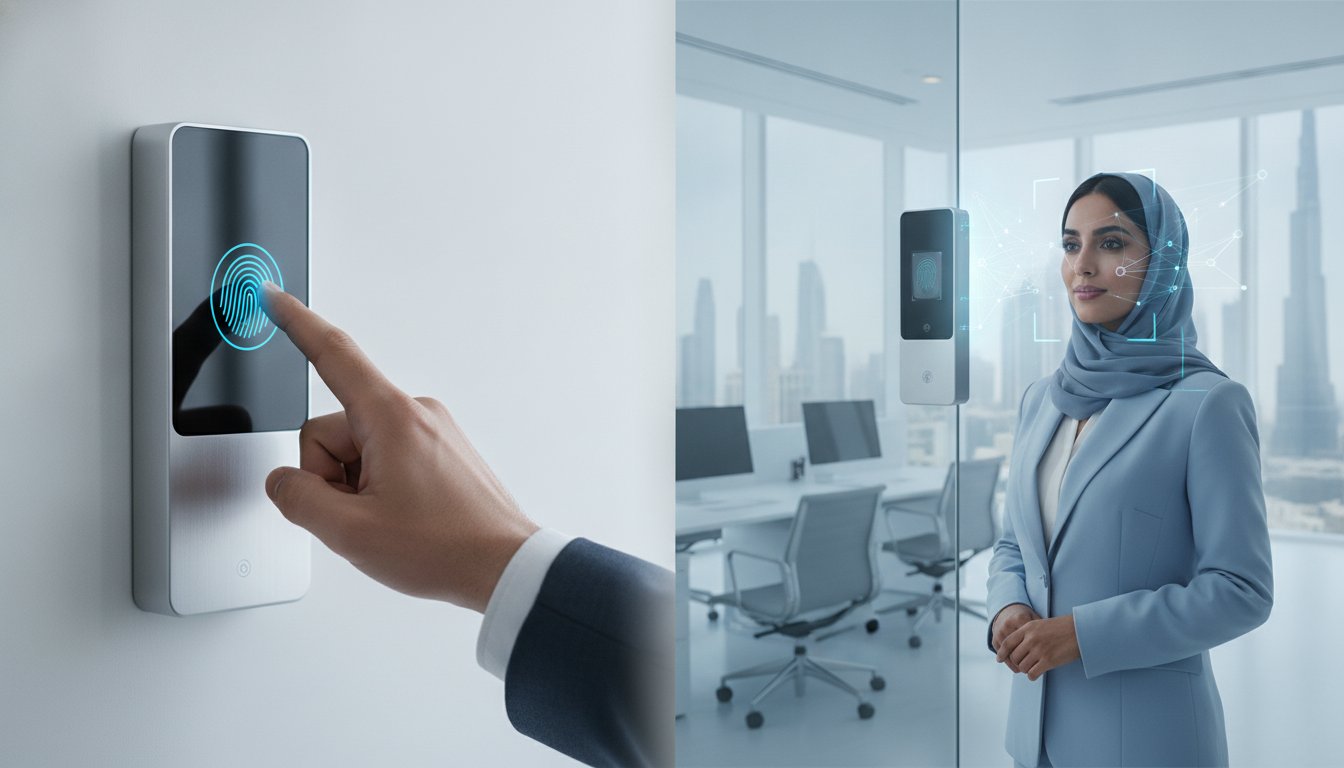
Fingerprint recognition has long been the global benchmark for organizations seeking a cost-effective and highly accurate method of employee tracking. It’s a reliable choice for businesses that prioritize budget without sacrificing security. Conversely, facial recognition technology provides a premium, touchless experience that aligns with modern corporate hygiene standards and increases throughput speed. When comparing a fingerprint vs face recognition attendance system, technical metrics like the False Acceptance Rate (FAR) and False Rejection Rate (FRR) are critical. FAR measures the likelihood of an unauthorized user being granted access, while FRR tracks how often a legitimate user is incorrectly denied. High-quality systems minimize both to ensure operational uptime. For high-security environments, multi-modal systems that combine both technologies offer the most robust defense against unauthorized entry.
How Fingerprint Attendance Systems Work
Fingerprint scanners use optical or capacitive sensors to map the unique ridge and valley patterns on a person’s finger. Optical sensors essentially take a high-resolution photograph, while capacitive sensors use electrical currents to create a digital map. Modern scanners are equipped with “live” finger detection to prevent spoofing with silicone molds or photographs. These systems are ideal for industrial sites where facial recognition might struggle with heavy dust or for small offices looking for a dependable entry-level solution. If you’re considering an upgrade, a professional door lock attendance machine installation ensures these sensors are calibrated correctly for your specific environment.
The Mechanics of Face Recognition Technology
Advanced facial recognition systems utilize 3D mapping and infrared sensors to verify identity, which is far more secure than basic 2D image matching. Infrared sensors allow the machine to function in low-light conditions and distinguish between a real face and a high-resolution printout. These systems are governed by evolving facial recognition technology standards that ensure accuracy even when employees change their eyewear, grow facial hair, or experience slight changes in lighting. Because it’s touchless and fast, facial recognition is the preferred choice for high-traffic corporate lobbies and healthcare facilities where hygiene is paramount. Choosing between these technologies depends on your specific traffic patterns and security needs, but both offer a significant leap over legacy card systems.
Environmental and Hygiene Factors: Choosing the Right Fit for the UAE
The environmental conditions in the United Arab Emirates present unique challenges for biometric hardware that generic guides often overlook. High humidity levels and pervasive fine dust can significantly impact the longevity and accuracy of your selected devices. When evaluating a fingerprint vs face recognition attendance system, it’s essential to consider how these atmospheric factors interact with different sensor types. While fingerprint scanners offer a compact and cost-effective solution, their reliance on physical contact makes them more vulnerable to surface degradation in dusty environments. Facial recognition systems, being entirely contactless, avoid many of these surface-level issues but require stable lighting and clean lenses to maintain their high verification speeds. If your office prioritizes a sterile, high-speed entry experience, then facial recognition is often the superior choice for long-term reliability.
To ensure consistent performance in the local climate, organizations must adhere to specific maintenance protocols. These include:
- Optical sensors: Daily wipes with microfiber cloths to remove skin oils and accumulated dust.
- Facial cameras: Weekly lens inspections to ensure smudges or glare don’t interfere with 3D mapping.
- Database management: Regular optimization of the user database to maintain matching speeds as your headcount grows.
Hardware Durability in National Climate Conditions
Fine dust particles are a constant reality in the UAE, especially for businesses located near construction zones or industrial hubs. These particles can accumulate on the glass plates of optical fingerprint scanners, leading to higher False Rejection Rates as the sensor struggles to read the ridges of a finger. If your facility is a warehouse or a semi-outdoor site, choosing IP-rated (Ingress Protection) hardware is mandatory to prevent internal component failure. Humidity also plays a role; excessive moisture can cause condensation on sensors, which temporarily disables the device. Ensuring a consistent power supply is equally vital, as voltage fluctuations can lead to data corruption if the hardware lacks robust internal surge protection.
The Hygiene Argument for Touchless Systems
Post-pandemic workplace standards have permanently shifted employee expectations toward touchless interactions. Facial recognition has become the corporate default in many UAE and Abu Dhabi offices because it eliminates the need for hundreds of employees to touch the same surface daily. This contactless approach reduces the transmission of germs and aligns with modern health and safety protocols. Employee perception is also a factor; many teams prefer the frictionless feel of facial recognition, as it allows them to clock in while walking toward the entrance without stopping to align a finger perfectly on a pad. Balancing these hygiene benefits with your specific security needs will determine which system provides the best value for your organization.
Planning Your Attendance Machine Installation and IT Integration
The success of your biometric deployment depends on technical synergy rather than just hardware selection. While the debate over a fingerprint vs face recognition attendance system often focuses on the user interface, the underlying IT integration determines long-term reliability. In 2026, the benchmark for a biometric attendance machine UAE requires hardware that communicates flawlessly with your existing digital infrastructure. It isn’t enough to simply mount a device on a wall. You must ensure the hardware is synchronized with your HR and payroll platforms to automate reporting and reduce administrative overhead. Proper software configuration allows for real-time data flow, which is essential for maintaining accurate records and meeting local regulatory standards.
Networking and Power Requirements
A robust network installation for office UAE environments serves as the backbone of any biometric deployment. While some entry-level devices use standalone storage, modern professional systems require a constant connection to sync data. Power over Ethernet (PoE) has become the preferred installation method because it delivers both power and data through a single cable, resulting in a cleaner look and easier maintenance. If your facility relies on wireless connectivity, ensure your Wi-Fi access points are configured to handle the consistent data traffic generated by multiple terminals. This prevents latency issues that could lead to log failures during peak morning hours.
Door Lock and Physical Security Integration
Integrating attendance hardware with physical security creates a seamless experience for staff while hardening your office perimeter. A professional door lock attendance system requires a methodical approach to installation:
- Site Survey: Identify optimal mounting heights and lighting conditions. This is especially important for facial recognition to avoid glare from glass partitions or direct sunlight.
- Hardware Selection: Install electromagnetic or drop-bolt locks that are fully compatible with the attendance machine’s relay outputs.
- Safety Compliance: Configure the system’s “fail-safe” or “fail-secure” modes. Fail-safe ensures doors unlock during power outages or fire alarms, which is critical for UAE fire safety compliance.
- Response Testing: Perform final testing to ensure the response time between a successful scan and the lock releasing is less than one second.
If you are ready to secure your office perimeter and streamline your time-tracking, our team provides expert door lock attendance machine installation tailored to your specific facility layout.
Custom Security Solutions: Why Professional Installation Matters
Purchasing a biometric device is a straightforward transaction, but achieving consistent operational uptime requires a deeper level of technical expertise. Off-the-shelf biometric devices frequently underperform because they lack the specific configuration needed to handle high-traffic environments or complex local networks. Whether you’ve selected a fingerprint vs face recognition attendance system, the hardware’s success depends on precise calibration and a stable data environment. Professional installers bridge this gap by ensuring that every sensor is tuned to the unique lighting conditions and usage patterns of your specific UAE office. If you’re still weighing the pros and cons of a fingerprint vs face recognition attendance system for your facility, remember that the quality of the installation often outweighs the specific technology chosen.
At ZD Computer Trading LLC, we focus on providing comprehensive solutions that go beyond simple hardware procurement. We understand that a door lock attendance machine is a critical component of your office’s operational heartbeat. Our technicians specialize in aligning high-end hardware with reliable technical service, ensuring that your investment provides long-term value. If your system is poorly configured, it won’t just fail to log attendance; it could also create vulnerabilities in your access control perimeter. Professional oversight ensures that your security infrastructure remains a stable, invisible asset to your business.
The Value of Expert Technical Support
Expert calibration is the primary defense against high false rejection rates. If a fingerprint scanner isn’t properly sensitized to the environmental dust levels discussed earlier in this guide, legitimate staff will face repeated entry denials. Beyond physical calibration, professional support includes the vital management of firmware updates. These updates are necessary to protect biometric data from evolving cyber threats and to ensure compatibility with new HR software. Providers with a background in specialized services like printer repair and general IT maintenance bring a holistic view to your office technology. They understand how different hardware components interact, which allows them to troubleshoot network conflicts before they disrupt your payroll reporting.
Scaling Your Security Infrastructure
Future-proofing is a core consideration for any growing UAE enterprise. A well-designed system allows for the seamless addition of terminals as your headcount increases or as you expand into new office wings. Integration is also key; your attendance data should ideally work in tandem with other security layers. For instance, aligning your biometric logs with business CCTV network requirements UAE standards provides a visual audit trail for every entry event. This multi-layered approach ensures that your facility remains secure and your records remain beyond reproach. To ensure your office is equipped with a reliable, scalable solution, Consult with ZD Computer Trading for your custom attendance setup today.
Securing Your Professional Future with Biometric Precision
Selecting a fingerprint vs face recognition attendance system is a critical step toward modernizing your office operations and ensuring payroll integrity. While fingerprint scanners offer a dependable and cost-effective entry point, facial recognition provides the touchless, high-speed experience required for contemporary hygiene standards. Regardless of the technology you choose, the reliability of your system hinges on professional calibration and a robust IT backbone that can withstand the UAE’s unique environmental conditions.
A successful deployment requires a partner who understands the intricacies of network synergy and door lock integration. ZD Computer Trading LLC provides the technical expertise needed to bridge the gap between sophisticated hardware and consistent operational uptime. With our national UAE technical support coverage and comprehensive networking capabilities, we ensure your facility remains secure and your data remains accurate. Our team is ready to assist with the expert installation of door lock attendance systems and full IT integration to support your growing team.
Upgrade your office security with professional attendance machine installation from ZD Computer Trading to experience the peace of mind that comes with expert integration. We look forward to helping you build a more efficient and secure workplace.
Frequently Asked Questions
Is facial recognition more accurate than fingerprint scanning for office attendance?
Both technologies offer near-perfect accuracy when properly calibrated, but facial recognition often performs better in environments where physical factors might interfere with sensors. While a fingerprint scanner relies on clear ridge patterns, facial recognition uses 3D mapping that remains effective even if an employee has dry skin or minor surface injuries. When comparing a fingerprint vs face recognition attendance system, the choice usually depends on your specific environment rather than a significant difference in raw accuracy metrics.
Can a biometric attendance system be integrated with my existing payroll software?
Modern biometric hardware is designed to sync seamlessly with most HR and payroll platforms through API integrations or automated CSV exports. This connectivity allows your attendance data to flow directly into your financial systems, which eliminates the risk of manual entry errors and significantly reduces administrative overhead. It’s essential to verify software compatibility during the installation phase to ensure your reporting remains automated and accurate for every pay cycle.
What happens to the attendance system if the office Wi-Fi goes down?
Professional biometric terminals feature internal storage that continues to log employee timestamps even when the network connection is lost. Once your Wi-Fi or local area network is restored, the device automatically synchronizes the cached data with your central server. This fail-safe mechanism ensures that no attendance records are lost during technical outages, providing consistent operational uptime for your business without requiring manual intervention from your IT team.
Are fingerprint attendance machines hygienic for large teams?
Fingerprint scanners require physical contact, which can present hygiene challenges in high-density workplaces or healthcare settings. While these devices are highly effective, they require a regular cleaning schedule with appropriate microfiber cloths to maintain both hygiene and sensor clarity. Many UAE organizations are now opting for facial recognition as a touchless alternative to provide a more sterile and frictionless entry experience for their staff members.
Do I need to upgrade my office door locks to install an attendance system?
You don’t always need new locks, but your existing hardware must be compatible with the attendance machine’s relay outputs to function as an access control system. In many cases, installing electromagnetic or drop-bolt locks is the most reliable way to ensure the system can physically grant or deny entry. A professional site survey will determine if your current door infrastructure can support a fingerprint vs face recognition attendance system without requiring a full hardware overhaul.
How many user templates can a standard biometric attendance machine store?
Storage capacity varies by model, but standard professional terminals typically support between 1,000 and 3,000 facial profiles or up to 5,000 fingerprint templates. For larger industrial sites or multi-branch corporations, high-capacity models are available that can manage over 10,000 unique users. It’s important to choose a device that accounts for your current headcount while leaving sufficient room for future team expansion and guest access requirements.
Is biometric data stored on these machines secure from hacking?
Security is a primary feature of professional biometric hardware, as these systems store data as encrypted mathematical strings rather than actual images. This means that even if the internal database were accessed, the encrypted templates couldn’t be reconstructed into a usable fingerprint or facial image. Maintaining regular firmware updates and following secure network protocols further hardens the system against unauthorized access and protects sensitive employee information.
Can facial recognition systems identify employees wearing masks or glasses?
Advanced facial recognition systems utilize infrared sensors and 3D mapping to identify unique facial structures even when employees wear medical masks or eyewear. These algorithms focus on the geometry of the forehead, nose bridge, and eye area to maintain high verification speeds. This capability ensures that your security protocols don’t become a bottleneck during the morning rush, even in environments where personal protective equipment is a standard requirement.
